



30th Mar 2026
Decking Screws, Joists & Supports: How to Get It Right First Time
Most decking problems start before the boards even go down. From the base through to decking screws, this guide covers what to get right.
Decking screws might seem like a small detail, but they’re what hold your entire build together, and choosing the right ones can make or break the job.
Get the fixings wrong, and it doesn’t matter how good your boards or frame are, you’ll end up with movement, or a finish that won’t last.
Most problems on-site don’t come from lack of effort. They come from:
- Using the wrong fixings
- Poor joist spacing
- Weak or uneven support systems
That’s where the right tools and setup make all the difference. This guide answers the exact questions people search for, from decking screws to how to lay decking, and shows you how to work faster without cutting corners.
If you’re serious about getting the job done right, Get Kitted Out connects you with the tools, brands, and local experts who actually understand your trade.
Start with the Base: Ground Prep and Decking Supports
Decking supports are the foundation of any decking build, providing a stable base for decking joists and ensuring the entire structure stays level and secure over time.
Before installing decking supports, the ground should be properly prepared to create a reliable surface. This includes:
- Clearing vegetation and topsoil
- Creating a level, compacted surface
- Adding a weed membrane and, where needed, a sub-base such as MOT Type 1 or gravel
A well-prepared base allows decking supports to sit evenly and improves long-term performance.
Once your decking supports are in place, including systems like adjustable decking feet, setting out the frame becomes much more efficient. You can:
- Set accurate heights across the build
- Create a consistent, level working surface
- Make small adjustments as decking joists are installed
This stage directly supports faster installation of decking joists and helps keep spacing consistent across the frame.
With a solid base and properly installed decking supports, the rest of the build flows more smoothly, allowing you to work faster while maintaining a high-quality finish.
Build the Frame: Decking Joists That Keep Everything Straight
Decking joists form the structural frame of your deck, supporting the boards above and helping distribute weight evenly across the entire surface.
Well-installed decking joists create a level, stable base that keeps boards aligned and properly supported over time. Consistent spacing and accurate installation also help ensure fixings like decking screws sit securely.
How far apart should decking joists be is typically 400mm centres for standard timber decking, although this can vary depending on board type, thickness, and load requirements.
Spacing is usually reduced to 300mm centres for:
- Composite decking
- Thinner decking boards
- Diagonal board layouts
- High-traffic areas
Following manufacturer guidance is important, as recommended spacing may differ between materials.
Using wooden joists for decking remains the most common approach for domestic builds. For long-term performance, timber joists should be:
- Pressure-treated for outdoor use
- Installed above ground level using decking supports
- Positioned to allow airflow beneath the structure
Adding joist protection tape (DPC tape) on top of decking joists helps reduce water ingress and protects the timber from moisture sitting between the joist and decking boards.
Accurate installation of decking joists supports a stable structure, consistent board fixing, and excellent execution across the lifespan of the deck.
Strengthen the Frame: Noggins, Decking Brackets and Decking Joist Supports
Decking brackets, noggins, and decking joist supports play an essential role in reinforcing decking joists and maintaining a stable, long-lasting structure.
These components work together to support the integrity of the frame, helping decking joists remain aligned, evenly spaced, and securely fixed throughout the build.
- Noggins (short blocks fitted between decking joists) add rigidity and help prevent joists from twisting over time
- Decking brackets provide strong, reliable connections between timber sections and support accurate assembly of the frame
- Decking joist supports and hangers hold joists firmly in place, maintaining consistent spacing and structural stability
Used together, they:
- Reduce movement and flex within the decking frame
- Improve load distribution across decking joists
- Support consistent positioning for decking boards and decking screws
This stage strengthens the overall framework, ensuring decking joists remain secure and well-supported, which contributes to a stable surface for laying decking boards and achieving durability.
Decking Screws: Secure Fixings for a Strong and Lasting Finish
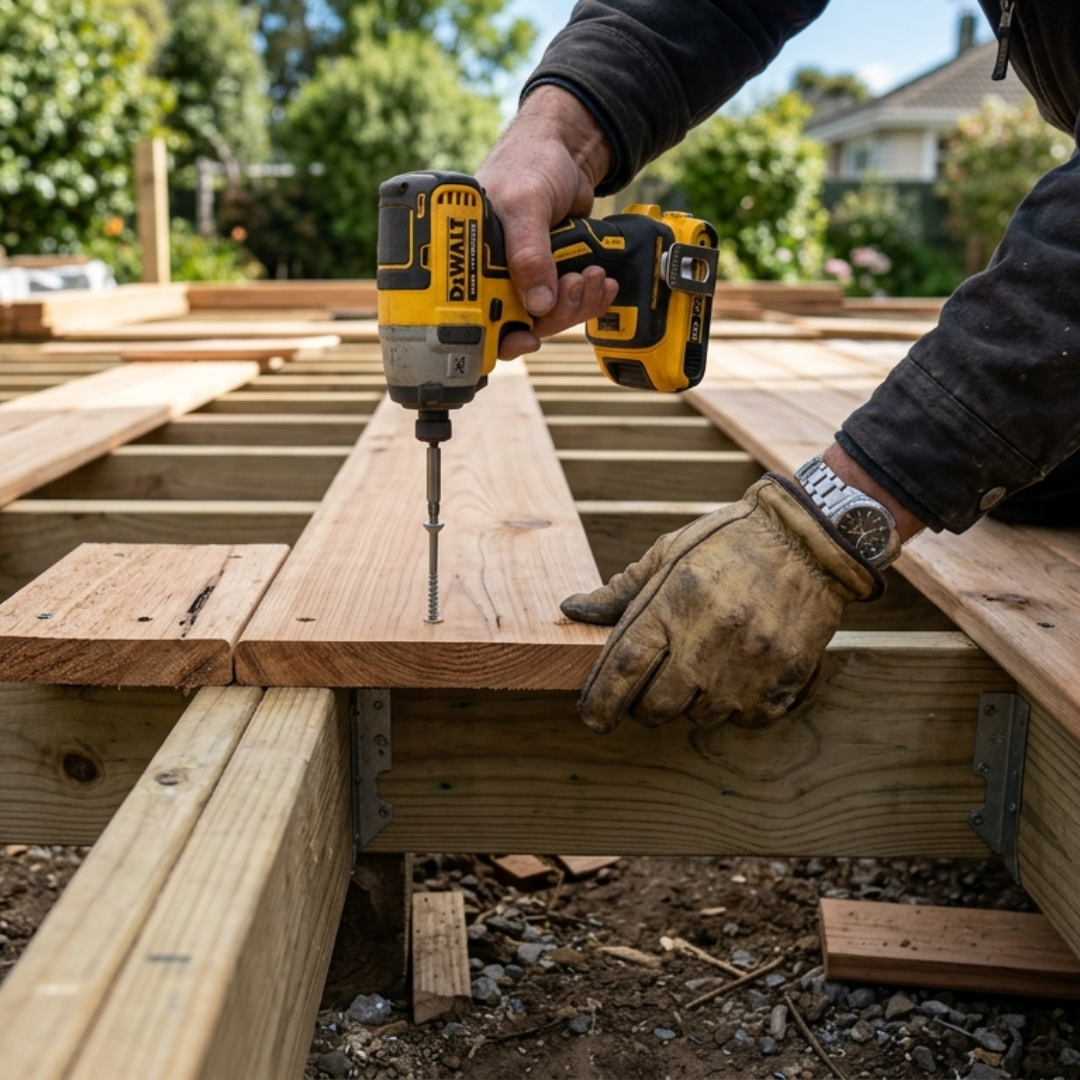
Decking screws are designed to secure decking boards firmly to decking joists, creating a stable surface and supporting the long-term performance of the structure.
Once the decking joists and decking supports are in place, decking screws provide the fixing method that holds each board consistently in position and maintains alignment across the deck.
High-quality decking screws are engineered for outdoor timber applications and offer several key benefits:
- Clean penetration into timber with reduced risk of splitting
- Strong thread grip for secure fixing into decking joists
- Countersunk heads that sit flush with the decking surface for a neat, professional finish
In many softwood applications, decking screws can be installed without pre-drilling. Hardwood decking boards may require pre-drilling to maintain accuracy and protect the material, particularly near board edges.
Correct fixing techniques are also important. Using two decking screws per joist per board helps distribute load evenly and keeps boards firmly in place over time.
Using appropriate decking screws supports consistent board spacing, secure fixing into wooden joists, and dependable execution across the full decking system.
Lay the Boards: How to Lay Decking the Right Way
How to lay decking properly, start with a solid subframe, consistent joist spacing, and secure fixing while allowing for drainage and natural movement.
A well-prepared structure, with level supports and evenly spaced decking joists, provides a stable base for laying boards and keeping everything aligned across the surface.
When laying decking boards:
- Leave 5-6mm gaps between boards to allow for drainage and expansion
- Use two decking screws per joist per board for a secure fixing
- Work in straight, consistent lines to maintain an even, professional finish
It is also recommended to introduce a slight fall away from buildings to help water run off and protect the structure over time.
Accurate board installation supports even spacing, secure fixing, and a clean, uniform appearance across the deck. At this stage, the supports, joists, and fixings come together to form a complete system that performs reliably over time.
Adjustable Decking Feet: The Shortcut That Changes the Whole Job
Adjustable decking feet are height-adjustable decking supports designed to create a level and stable base for decking joists across a range of ground conditions.
Used as part of a modern decking system, adjustable decking feet support consistent joist positioning and help maintain even load distribution across the structure.
They allow you to:
- Adjust height to suit different ground levels or surfaces
- Fine-tune positioning to keep decking joists level and evenly spaced
- Install decking supports directly onto suitable existing surfaces such as concrete or paving
Adjustable decking feet are commonly used with decking joist supports and work alongside wooden joists to create a secure and well-supported frame.
They are designed to sit on a stable, load-bearing base, ensuring well grounded support for decking supports, decking joists, and the decking boards fixed above using decking screws.
Tools That Support a Reliable Decking Build
Each stage of the build contributes to the overall structure. A stable base supports accurate placement of decking supports, which in turn hold decking joists in position. Components such as decking brackets and decking joist supports reinforce the frame, while decking screws secure decking boards firmly to the joists.
This coordinated approach supports:
- Consistent alignment across decking joists and boards
- Secure fixing with decking screws into wooden joists
- Even load distribution throughout the decking structure
When each element is installed correctly and works in alignment, the result is a decking system that remains stable, well-supported, and built for long-term performance.
Get Kitted Out: Built for Your Trade
Get Kitted Out connects you with:
- Trusted local stockists
- Premium brands
- The right tools for the job
The UK & Ireland’s biggest network of independent tool stockists, 2,250 stores strong Great Tools. Real People. Right Here.
Summary
Building decking successfully comes from following a structured approach where decking supports, decking joists, decking joist supports, decking brackets, and decking screws all work together as one complete system.
A well-prepared base supports accurate installation of decking supports, which provide a stable foundation for decking joists. Consistent spacing of decking joists, based on guidance such as how far apart should decking joists be, helps maintain strength and alignment across the frame.
Using wooden joists for decking, combined with protection methods such as joist tape, supports long-term durability. Reinforcement with decking brackets, noggins, and decking joist supports helps keep the structure secure and evenly distributed under load.
Final installation of decking boards using decking screws ensures each board is fixed firmly to the joists, maintaining consistent spacing and a clean, professional finish. Following best practice for how to lay decking supports good performance and a stable surface over time.
When each stage is completed with the correct materials and methods, the decking structure remains level, secure, and built for long-term use.
Every one of our Get Kitted Out Approved Stockists are dedicated to ensuring total value for money, so if you’re also in search of tools and accessories at the best possible price, find your local Stockist right here.